Key takeaways
- A pond needs the right soil and enough drainage area to stay full.
- Dams need compaction, a safe spillway and good grass cover.
- Seeps, slumps and burrows are early warnings worth checking.
- Buffers and stable banks protect water quality and the shoreline.
Will a pond hold water?
The soil decides. Clay holds water well, and sandy or rocky soil can leak. A pond also needs a drainage area large enough to fill it and not so large that storm flows overwhelm it. A site visit and soil testing answer both questions.
The Natural Resources Conservation Service and your local extension office can help evaluate sites.
Dams and spillways
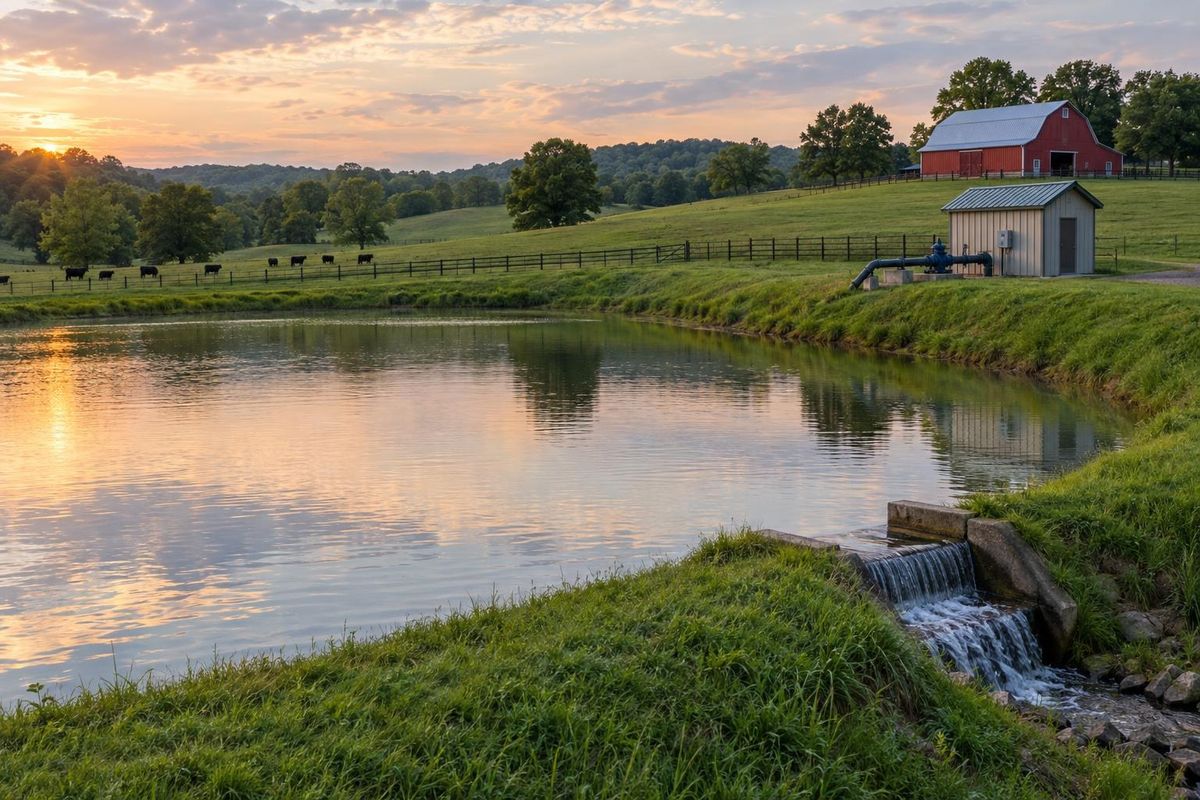
A dam is built in compacted layers from suitable soil, with a core trench in many designs. The spillway is just as important: it carries storm flows safely around or over the dam without eroding it. Pipes through the dam need anti-seep collars.
Keep the dam covered with grass, free of trees and burrows and mowed regularly.
Warning signs
Damp spots on the downstream face, a growing seep, a sag along the crest, cracks, sinkholes, muskrat or groundhog burrows and an eroding spillway all deserve attention. Act early, because small problems are easier to fix than big ones.
After heavy rain, walk the dam and look.
Banks, buffers and water quality
Planted buffers of native grasses and shrubs hold banks together, filter runoff and shade the water. Fencing livestock away from the shoreline and providing a hardened access point protects banks and water quality.
Aeration and nutrient control help keep farm ponds healthy and fishable.
Official sites to explore
Brand names and logos belong to their owners. These links open the official websites in a new tab, and we are not affiliated with them.
- USDA Natural Resources Conservation ServiceConservation guidance and programs for ponds, soil and water on farms.
- University of Tennessee ExtensionResearch-based guidance on land, water, plants and wildlife in Tennessee.
- U.S. EPA: Nonpoint Source PollutionHow runoff affects water quality and how to reduce it.
- U.S. Geological SurveyScience and data on water, geology and the environment.
- Metro Water Services: StormwaterStormwater and erosion control information for Nashville.
Quick answers
How deep should a farm pond be?
Deep enough to stay healthy through summer and winter. Many farm ponds have a deep area of around eight to ten feet or more.
Do I need permission to build a farm pond?
It can depend on size and location. Check with local authorities and the conservation district.
Can I get help paying for conservation work?
Some programs may help. Ask your NRCS office and local conservation district what is available.